This article is part of the FA special series Everywhere Walls, Borders, Prisons.
In “Black Flags: The Rise of ISIS,” a chronicle of the life and career of ISIS “grandfather” Abu Musab al Zarqawi, journalist Joby Warrick opens with a description of Al Jafr prison in southeastern Jordan, where al Zarqawi was incarcerated between 1992 and 1999. Warrick describes the prison as:
The most notorious of Jordan’s prisons […] known for decades as the place where troublesome men went to be forgotten. […] It was at this spot that British military overseers chose to build an imposing prison with limestone walls and high watchtowers for detainees regarded as too dangerous for ordinary jails.
Warrick’s description of Al Jafr is both technically accurate—the British did indeed build its limestone walls and watchtowers—but historically inaccurate on one crucial detail. The British did not build Al Jafr as a prison, nor did they ever use it as such during Britain’s Mandatory occupation of Jordan between 1921 and 1946. Rather, Al Jafr was originally constructed as a very different site of control—one of Britain’s so-called “desert outposts,” a series of stone fortifications built throughout the desert regions to control, surveil, and circumscribe the movements and behaviors of the desert’s nomadic pastoralist Bedouin inhabitants.
Beginning in the mid-1920s in Iraq’s southern desert, British Mandatory authorities developed and implemented a scheme for so-called “desert control,” aiming to exert domination not only over the desert itself — a landscape that appeared unknown and undeveloped in the eyes of the colonial authority — but more importantly, over the desert’s Bedouin communities. Formalized in the 1930 “Policy for Desert Control,” the strategy was experimented with in southern Iraq before being expanded and perfected in the desert regions of British Mandatory Transjordan and Palestine. Desert control revolved around the construction of so-called “desert outposts” — a network of militarized forts and police stations, all constructed at key Bedouin wells and watering places, at which government representatives could surveil and punitively withhold water from migrating Bedouin tribes. From these architectural nodes at strategic locations, the British imperial presence and authority radiated outwards throughout the desert.
Al Jafr in south-central Jordan was one of these desert outposts. A fort originally constructed during World War I by a local Bedouin leader to denote ownership of adjacent water resources, the building was later seized by the British administration and adapted into one of Britain’s desert control sites. After independence, the site was transformed again into Jordan’s most notorious prison, used for the incarceration of political prisoners, and its remote desert location leveraged by the government to commit any number of human rights abuses.
Sites such as Al Jafr prison, where political dissidents are disappeared and tortured en masse, loom large in the popular imagination of authoritarian governance in the modern Middle East. But these prisons are a relatively recent phenomenon. The British Mandate largely eschewed the use of prisons as a means of population control (one exception was in Palestine during the 1936-39 Arab revolts, during which the British built a massive prison system that was later taken over and expanded by the Israeli government). Instead, the British (and, in a similar vein, the French Empire in today’s Syria and Lebanon) introduced militarized outposts and police stations to the deserts of the Mandatory territories, a building typology that was initially non-carceral. One British administrator celebrated that the objectives of desert control had been achieved “without putting a single tribesman in prison”. But Al Jafr was far from the only British desert outpost turned prison after independence. Mandatory administrators continuously insisted that they had not built prisons for the Bedouin, thereby attempting to make some claim at benevolence. But to what extent is a site built explicitly for population control different from a prison? What does it say about Britain’s desert control scheme that its architecture was so readily adapted into a carceral one?
While forms of state population control through architecture were practiced by Britain’s imperial predecessors in the region, from the Ottomans to the Umayyads to the Romans, Britain’s desert outposts were noteworthy in their exclusionary design. The late antique Umayyad qusur, so-called “desert castles,” of which dozens exist throughout the deserts of the Levant, are generally thought by scholars to represent a form of state diplomacy towards the Bedouin. While the castles certainly functioned to extend government presence into the deserts, they were also sites where Bedouin elites would meet with government representatives for negotiations while partaking in hunting and feasts. In the late 1800s, the Ottoman Empire developed a number of cities — Biʾr as-Sabaʿ in southern Palestine, Ramadi and Nasiriyah in Iraq — for the purposes of easing state oversight of the Bedouin and, eventually, settling Bedouin populations. But these urbanization projects were undertaken with the active participation of local Bedouin elites.
By contrast, Britain’s desert outposts were fortified against the imagined threat of Bedouin attacks and made inaccessible to the Bedouin they were meant to control. The British administration intended the outposts to emanate the impression of constant government surveillance, panopticon-like, throughout the deserts. The outposts’ later conversion into high-security prisons, black boxes into which political dissidents disappeared and did not always reemerge, may seem like a radical departure from their original intended function. But as the history of Al Jafr proves, the only difference between a colonial police station and an autocrat’s prison is the state’s outward gaze turning inward.
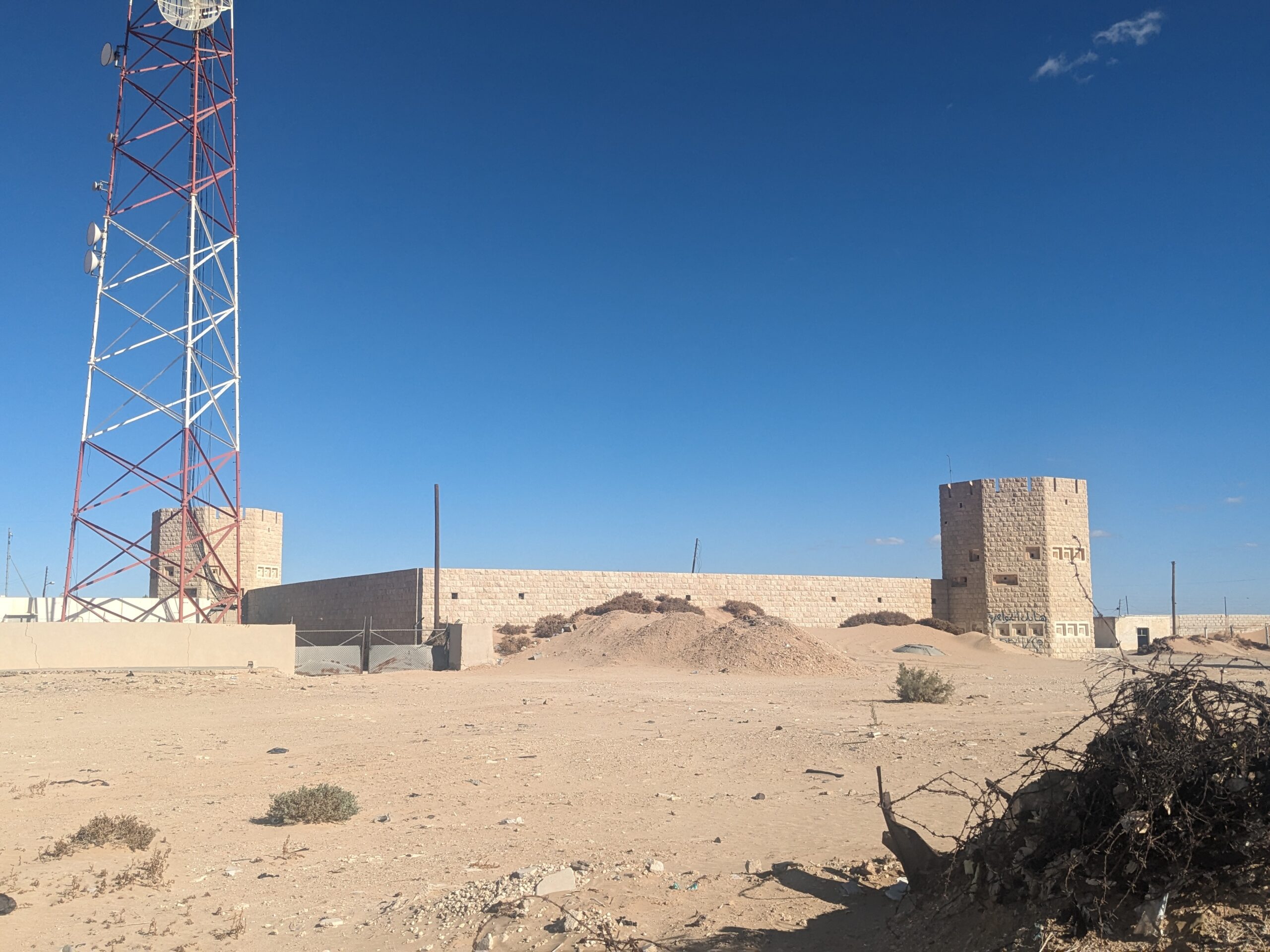
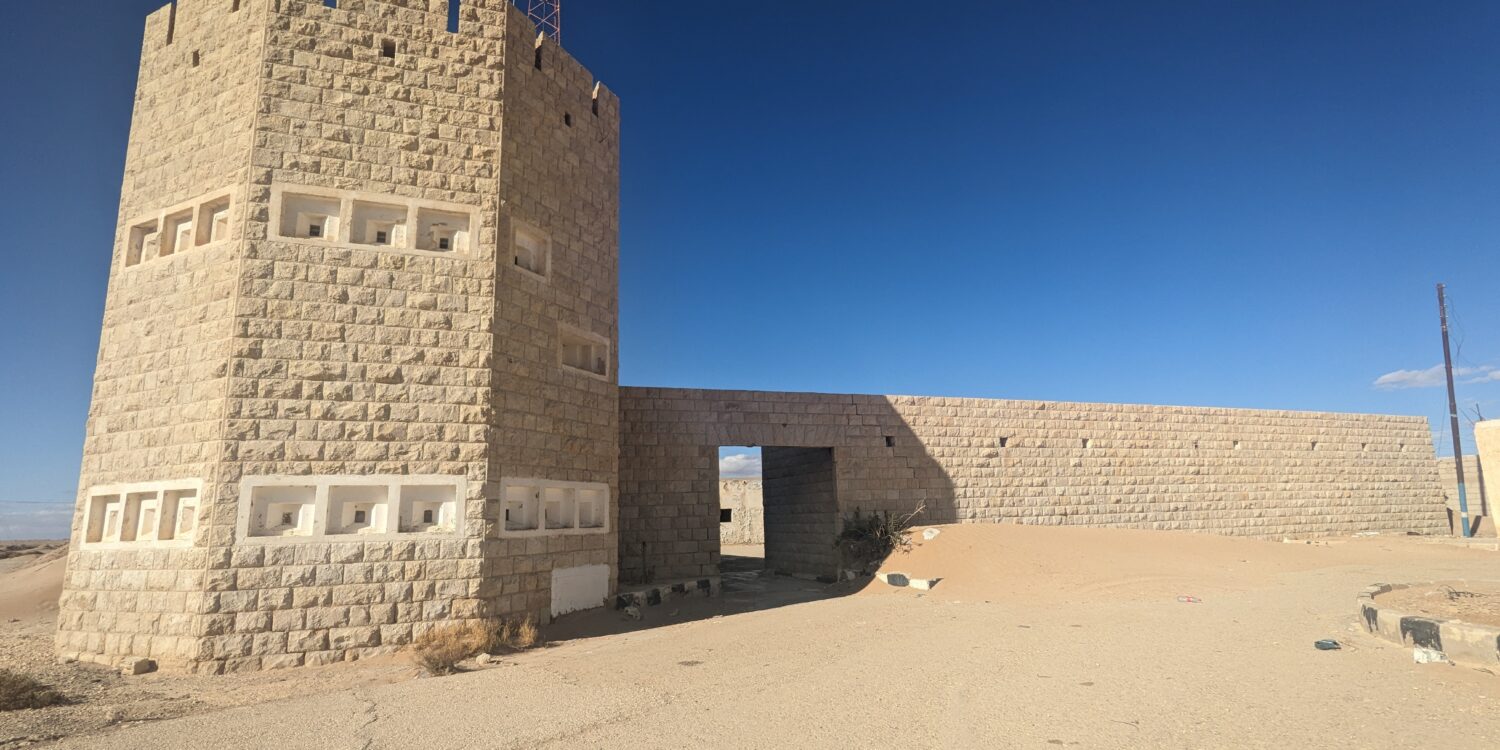
The British desert outpost-turned-prison at Al Jafr, 2024
Maggie Freeman
Before they were prisons, the desert outposts controlled Bedouin bodies by controlling the material a body needs to live: water. Each desert outpost was strategically situated at a major well or watering place where migrating Bedouin tribes would seasonally, and predictably, stop and camp to collect water for themselves and their animals. In some locations, authorities planned the outposts such that they physically surrounded and enclosed the available water resources; everywhere, police forces were assigned to control the distribution of water, including refusing water to Bedouin individuals or tribes deemed criminal or otherwise threatening to the state.
John Glubb was Britain’s chief liaison to the Bedouin in Iraq and Jordan and author of the “principles for desert control.” He later articulated the effectiveness of this strategy in an oral history interview: “The desert of course depends on wells, most of the year […] so we built a fort on every well, with eight or ten men in it. The result was the tribes couldn’t get water unless they came in under the control of the forts. And that established complete control of the tribes.”
Another rationale for the outposts arose from the belief that nomadic peoples such as the Bedouin, defined by the Mandatory administration as “wanderers; Arabs who live under canvas,” are by definition not only unfamiliar with permanent architecture but afraid of it. One British administrator wrote of the imperative “to raise a building in the desert which would impress the imagination of the tent dweller with the strength of the government,” as “the tribesman would be more impressed by the exhibition of solid unmovable strength within his midst” than by any presence of military manpower. As Glubb put it, “The control of Government is based on buildings in the desert which prove that government has become permanently installed.”
The fortified stone desert outposts were built as an expression of British presence and authority in the desert regions and of British technological superiority over the “tent-dwelling” Bedouin. They eventually built seven outposts in Iraq, fifteen in Jordan, and fourteen in Palestine. However, the idea that the “imagination of the tent dweller” could be “impressed” by the construction of permanent fortifications was an imperialist fantasy – a fantasy that needed to be made reality, for the strategy of controlling the Bedouin through stone walls rather than guns or bombs to be effective. In order to realize this fantasy, and to create the “facts on the ground” which paint the Bedouin as inherently opposed to permanent architecture, British authorities seized, occupied, and often destroyed existing Bedouin-built forts.
Al Jafr is one such example. Before the British desert outpost another fort existed at Al Jafr, built under the patronage of Auda Abu Tayeh, leader of the Tayeh section of the Huwaytat, a powerful Bedouin tribal confederation which allied with the British during World War I’s Great Arab Revolt to overthrow the Ottoman Empire. The British paid enormous subsidies to their Bedouin allies, from which Abu Tayeh profited immensely. With part of his income from the British, he paid for the construction of a fort at Al Jafr, the site of a grouping of wells used by and considered to be the property of Abu Tayeh’s tribe. Abu Tayeh’s motives for constructing his fort at Al Jafr are not exactly known, but it is likely that the reasons included many of the same ones underlying Britain’s later desert outpost building scheme: to control and demonstrate his ownership of Al Jafr’s water resources, as well as to visually signal that Abu Tayeh was a man with sufficient economic, social, and political capital to undertake the construction of a permanent stone building in a remote part of the desert. In effect, Abu Tayeh’s fort was itself a version of “desert control.”
Abu Tayeh’s fort at Al Jafr was short-lived, however. It was not yet fully completed by the end of World War I, when British gold stopped flowing; nevertheless, a series of aerial surveillance photographs taken in 1926 and 1927 document Huwaytat Bedouin encampments in and around the fort. Beginning in 1930, however, the desert control policy was implemented in full force across Jordan’s southern desert. Under the policy, Abu Tayeh’s fort was seized (Abu Tayeh had since died and the fort was the property of his son, Muhammad) and occupied as a desert outpost. Despite Muhammad Abu Tayeh’s complaints to the administration about the seizure of his family’s property, in 1937 the British demolished the fort, and repurposed its masonry building blocks in the construction of a new, purpose-built desert outpost a stone’s throw away from the original fort. Abu Tayeh’s fort was evidence of Bedouin practices and patronage of permanent architecture; evidence that was erased in service of an imperialist narrative of nomadic peoples as diametrically opposed to permanent architecture. Today, all that remains of Abu Tayeh’s fort is a crumbling outline of its former central tower.
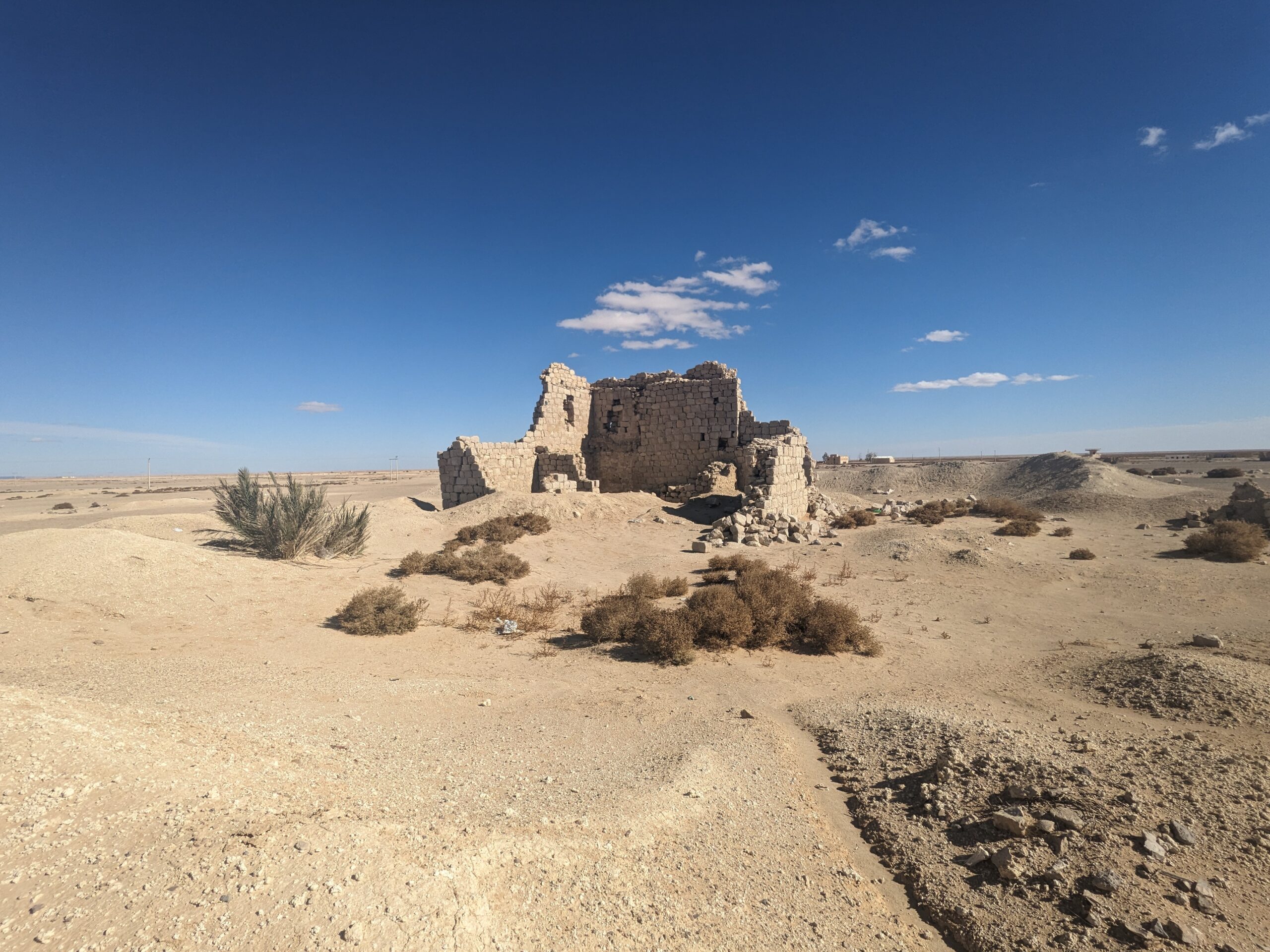
What remains of Auda Abu Tayeh’s fort at Al Jafr, 2024
Maggie Freeman
With Jordanian independence in 1946, the Al Jafr desert outpost took on a new life under the state’s new security imperatives. Forced to live in permanent settlements and integrated into military and political systems, the Bedouin no longer seemed to pose the same threat they once had to state legitimacy and authority. Meanwhile, however, a new political threat emerged in the form of Palestinian revolutionaries, communists, and anti-monarchists. From the 1950s onwards, these political prisoners were transported to and interred in the Al Jafr outpost. Its remote desert location, from which escape was difficult and where human rights abuses could be perpetrated outside of public knowledge, was readily leveraged in the creation of a prison that was, as Warrick put it in his biography of Al Zarqawi, “the place where troublesome men went to be forgotten.”
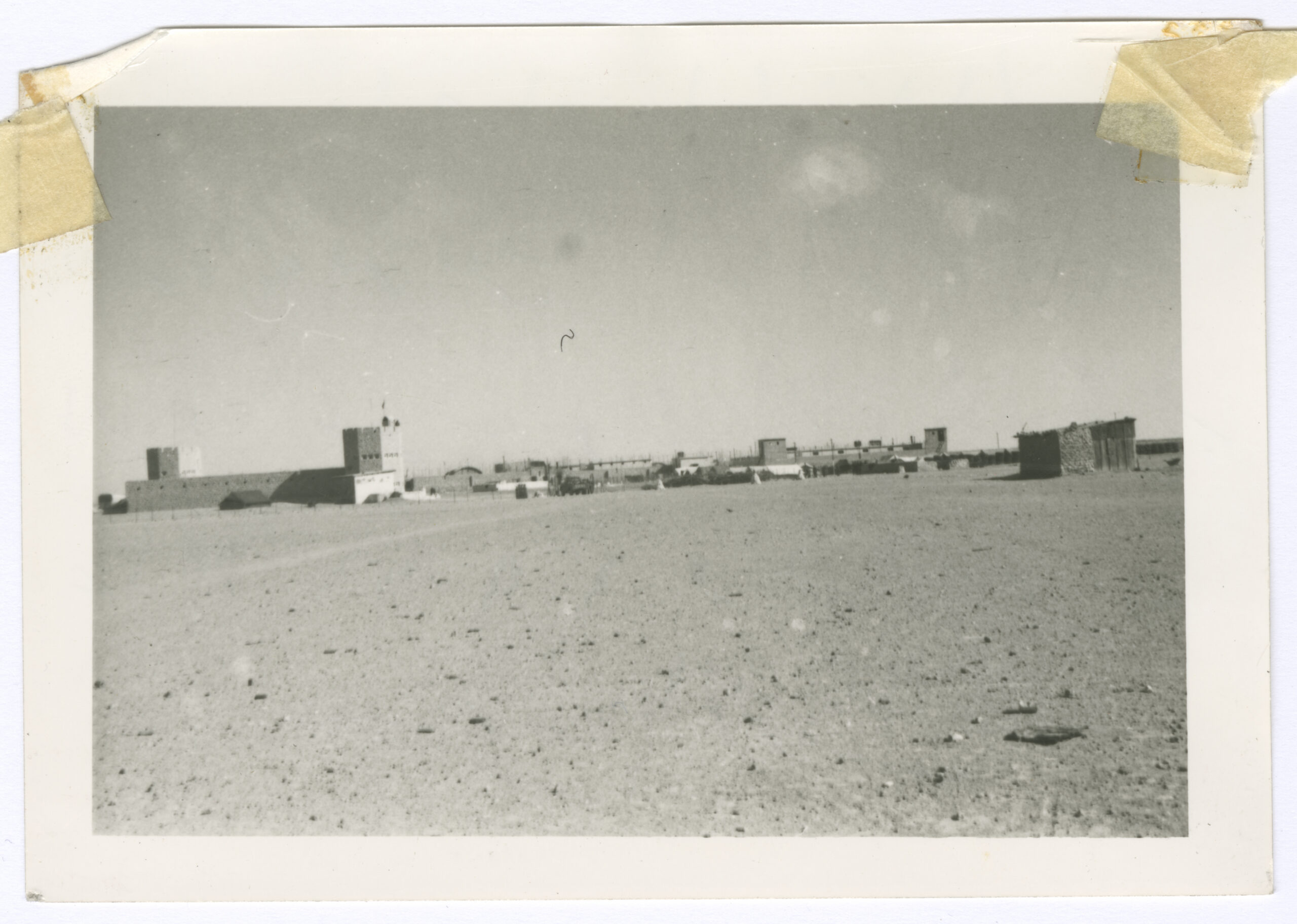
Al Jafr Prison, photographed 1961 by Mohammed Salem Thwaib
Al Jafr was not the only desert outpost turned prison. ‘Auja al Hafir on Israel’s Sinai border, a desert control site first developed by the Ottomans and later expanded by the British, is now home to Israel’s notorious Ktziot prison. Elsewhere, Glubb recounted meeting an Iraqi man who accused him of being the architect of Salman prison in southern Iraq, where the man’s brother had been incarcerated and killed. Glubb was in fact the architect of the Salman desert outpost, which had been turned into a prison after independence, “a desert concentration camp for political detainees.” Glubb professed that he had been acting out of pure “love and devotion” for the Iraqi people in constructing the desert outposts — that the outposts had been “a tower of refuge for the protection of many thousands of Iraqis” — and lamented that all his efforts had been “distorted into hatred and oppression” upon the outposts’ conversion into prisons. Salman was later one of the sites of Saddam Hussein’s Anfal campaign of Kurdish genocide. An untold number of Kurdish men, women, and children never reemerged from within the prison’s walls.
Al Jafr prison was temporarily closed in 1979 but re-opened in the early 1990s, as Jordanians who had gone to fight in Afghanistan’s mujahideen (militias who fought against the Afghan government and the Soviets) began to return to the country and brought hardline Islamist, anti-Western, and anti-government ideologies back with them. It was during this period that the Jordanian government imprisoned Al Zarqawi, recently returned from Afghanistan, at Al Jafr. Incarcerated from 1992 to 1999 on suspicion of attempting to overthrow the government, Al Zarqawi was freed due to an administrative error during a prisoner amnesty campaign on the occasion of King Abdullah II’s inauguration.
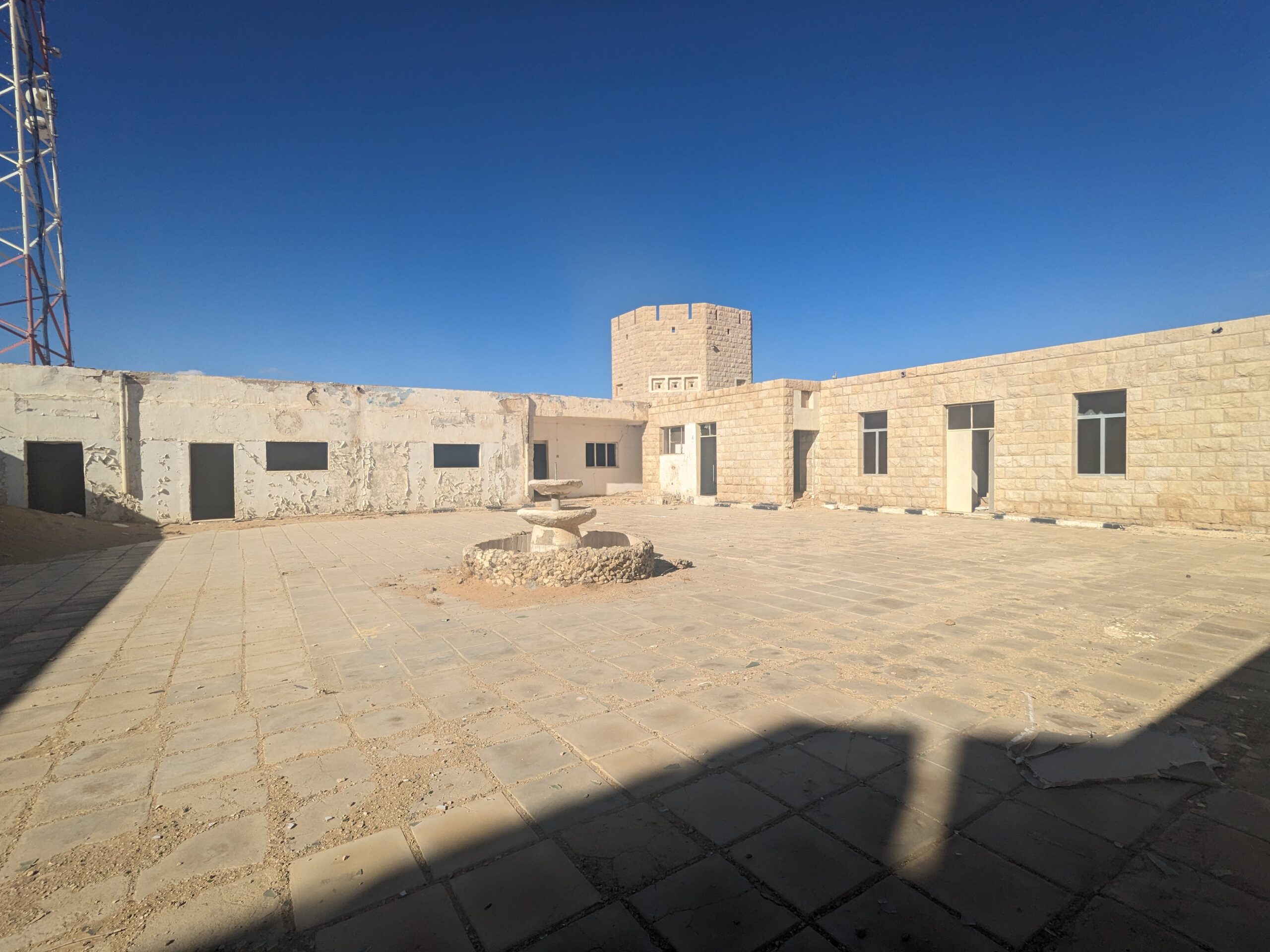
The building’s central courtyard with a water fountain, a common feature of British desert outposts for “beautification” purposes
Maggie Freeman
In 2006, the prison was closed after the National Centre for Human Rights published a report criticizing inmate conditions in the prison, but not before the prison was, allegedly, used as a CIA black site in the growing “Global War on Terror.” Today, the site is entirely abandoned. Upon my visit in January 2024 I was able to walk directly into the former outpost-cum-prison, its steel doors now removed and its fixtures and walls deteriorating but still intact. Outside the walls of the British-built fort, I could glimpse the remains of the tower of Auda Abu Tayeh’s fort across a short stretch of sand. Beyond that I could see modern Al Jafr in the distance, a settlement built during an intensive campaign of Bedouin sedentarization led by the Jordanian government in the 1960s and 1970s, during which many of the Huwaytat who had historically laid claim to Al Jafr, its wells and fort, were relocated into the new apartment buildings and houses.
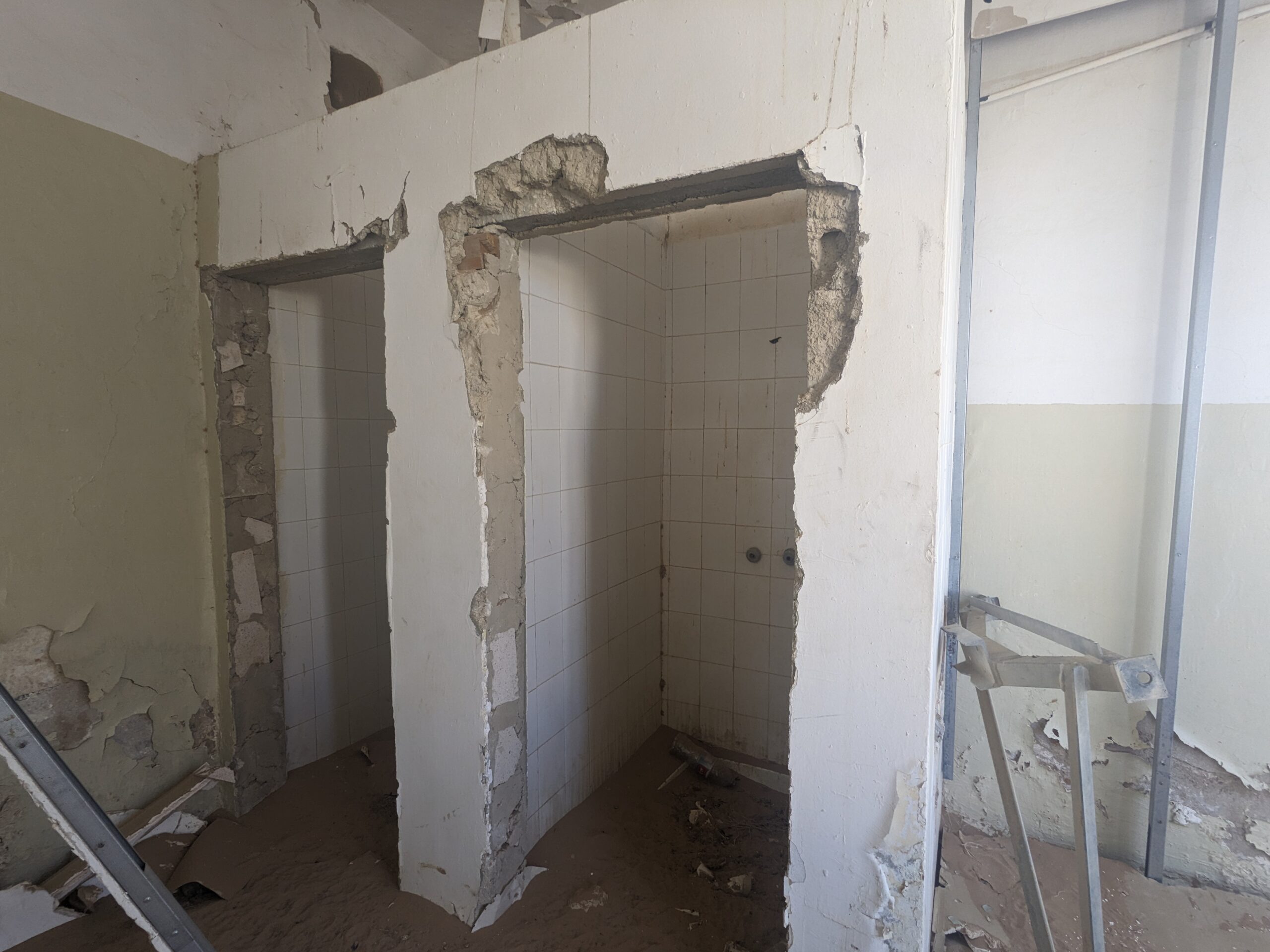
The interior of one of the shower rooms in Al Jafr
Maggie Freeman
The hulking remains of the prison, its two octagonal watchtowers projecting above the landscape, dominate the visitor’s impression of Al Jafr as well as the common understanding of the site’s history, as demonstrated by Joby Warrick’s misrepresentation of that history quoted at the beginning of this essay. But upon visiting the site, and delving into the British and Arabic sources on its history, a more nuanced and palimpsestic expression of control reveals itself. There is Abu Tayeh’s fort, built with the likely intention to control Al Jafr’s water resources and claim them as his own; there is the British desert outpost, built to control Abu Tayeh’s tribe and descendants with the very same stones as Abu Tayeh’s fort; there is the undetectable but lingering knowledge of the tortures and disappearances that occurred within the walls of the prison under Jordanian and CIA oversight; there is the Bedouin sedentarization village located just on the other side of the highway, itself an expression of government control over mobile peoples. Ultimately, Al Jafr reveals that once the idea of control has been built, it can prove disturbingly difficult to unbuild.